
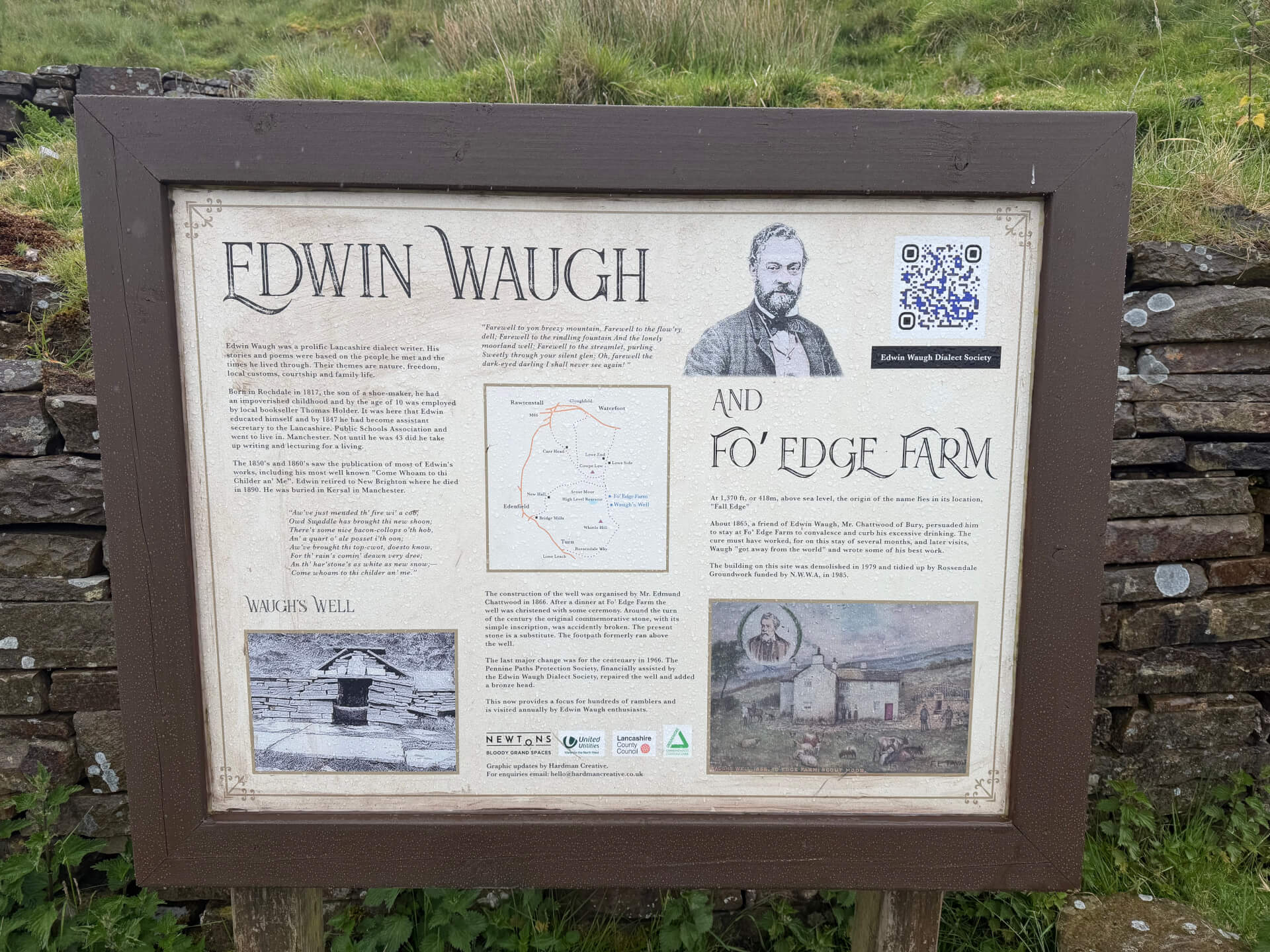
Waugh's Well sits high on Scout Moor, looking out over the open moorland above Scout Moor High Level Reservoir. It’s one of those spots that feels made for a pause, with stone benches, wide views, and a bit of breathing room after the climb. But behind the simple stone shelter is a proper Lancashire story, tied to Edwin Waugh, Fo' Edge Farm, and a patch of moor that helped shape some of his best writing.
Who was Edwin Waugh?
Edwin Waugh was born in Rochdale in 1817, the son of a clog-maker. His early life was hard, and after his father died when he was just nine, things got even tougher. He worked as a printer’s apprentice, taught himself, and eventually found his voice writing in Lancashire dialect, capturing the humour, grit and everyday life of working people across the county.
His poem Come Whoam to thi Childer an' Me, written in 1856, made his name. Waugh became known as the “Lancashire Burns” and the “Laureate of Lancashire”, which is a fairly serious title for a lad from Rochdale, but he earned it. His writing struck a chord because it sounded like real life, not polished-up nonsense.
Fo' Edge Farm and Waugh's retreat to the moors
By 1865, Waugh was in a rough patch. He was dealing with alcoholism, poor health and the strain of a difficult marriage. His friend Edmund Chattwood, a Bury manufacturer, suggested that he get away from it all completely. So Waugh was sent to Fo' Edge Farm, a remote farmhouse tucked below the Scout Moor ridge.
The farm was run by Bill and Ann Taylor, sometimes described in old accounts as “Bill o' Johnny's”. Up there on the moor, far from the temptations of the valley pubs, Waugh found a quieter rhythm. He wrote about the spring near the farm as a “rindle of cold spring water”, and that lonely, wind-bitten place gave him room to think and write. Some of his Lancashire Sketches were shaped during that time, along with other pieces that drew on the moorland landscape and the people he knew best.
The story of the well
The well itself was created in 1866, while Waugh was still alive, which makes it a bit unusual as literary memorials go. It was built by supporters who wanted to mark his connection with the area and give him a proper place of refuge on the moor. The stone structure, with its benches and sheltering walls, feels modest enough, but that’s part of the appeal. It suits the landscape and the man it honours.
Today, Waugh's Well is a lovely stopping point for walkers on the Rossendale Way and anyone wandering across Scout Moor. From here, the views stretch out towards Holcombe Moor, Musbury Tor and beyond, with the reservoir down below adding a bit of drama to the scene. On a breezy day, it’s easy to imagine why Waugh found the place so useful. It’s quiet, exposed, and properly removed from everything.
Walking to Waugh's Well
If you’re heading out to Waugh's Well, expect open moorland, big skies and weather that can change its mind in about ten seconds. It’s not a hard place to reach on the map, but the conditions can make it feel a bit more serious underfoot, especially after rain. Good boots are a sensible idea, and a layer that cuts the wind will usually earn its keep.
The best way to enjoy it is to slow down a bit. Sit on the stone bench, look out over the reservoir, and take in the fact that this quiet little shelter has been part of Lancashire literary history for well over a century. Not bad for a spot on the moors.
Fancy walking it yourself? Have a look at the Waugh’s Well hike page for the route details.